London Pride

London Pride is an annual event in London, comprising a march or parade in central London, together with a rally or festival, and sometimes other events.
Gay Pride Marches, subsequently re-branded as Pride Marches and now Pride Parades (see Pride) have been held in London since the early 1970s, normally on the nearest Saturday to 28 June, the anniversary of the Stonewall riots.
From 2004 to 2012, the London Pride events were organised by the charity Pride London.
Following widespread dissatisfaction following the last minute scaling back of World Pride 2012, the Mayor of London, Boris Johnson, invited community bodies to bid to run future Prides. In January 2013 it was announced that a community interest company London LGBT Community Pride had been awarded the right to run Pride for five years starting 2013.[1] The company is now branded as Pride in London.[2]
London Pride year by year
- More information needed to complete this section.
- 1971: There was a small march in 1971, organised by the GLF youth Group, starting with a Gay Day in Hyde Park and then a march down Oxford Street and Regents Street to Trafalgar Square.[3] There were about 200 marchers and a large number of police.[4]
- 1972: The first Gay Pride March under that name was held on the 1st of July 1972 and was organised by GLF. The date was chosen to be the nearest Saturday to the Stonewall riots of 1969. An estimated number of between 70 and 200 people took part in the march itself and maybe as many as 700 in the whole event, including the rally and picnic in Hyde Park.[5] [6]
- 1973: this year's Pride March was organised by CHE [7]. An estimated 300 people took part [8].
- 1976: Gay Pride week held in August. Tom Robinson performed Glad to be Gay! The number on the Saturday march was reported as between 800 and 2,000 [9].
- 1977: the Pride march and picnic was on Saturday 25th June and started at Temple Place, Embankment. Gay Pride Week lasted until 2 July.
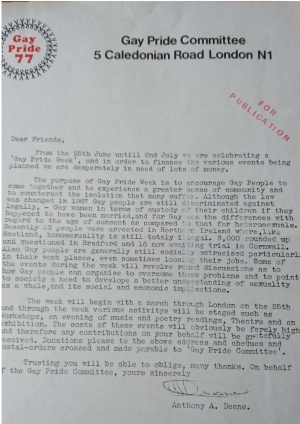
Gay Pride Committee letter 1977 - 1978: the Pride march was on Saturday 8th July and started in Sloane Square went via Earls Court, ending at Shepherd's Bush.[10]
- 1979: the Pride march was on Saturday 30th June and started at Temple Place, Embankment and marched to Hyde Park for an open air concert. Featured in two television documentary programmes; World in Action on ITV and Inside Story on BBC. [11].
- 1980: Approximately 3,000 marched. Frank Egan was arrested for having a vegetable cutter in his hat (as part of his drag costume). Clashes with the police occurred in Malet Street.[12]
- 1981: the Pride March was moved to Huddersfield for one year only, in protest against police harassment of the Gemini Club.[13]
- 1982: a very wet parade on the last Saturday (June 26th) in London. Started at Speakers' Corner, then through Piccadilly Circus ending up at the University of London Union in Malet Street for a dance. Capital Gay (2.7.82) reported over 1,200 attended and suffered torrential rain.
- 1983: held on 2 July starting in Hyde Park and ending at the University of London Union in Malet Street. Capital Gay (8.7.83) reported 2,000 attended 'on happiest Pride parade for years'.
- 1984: held on 30 June.[14]
- 1985: the march went from Hyde Park to the Jubilee Gardens. The number of marchers went up to an estimated 15,000, including mining communities showing solidarity in return for gay support during the miners' strike.[7] Capital Gay estimated attendance at 10,000 and called it, “the biggest gathering of homosexuals Britain has ever seen.”[15]
- 1986: March ends in Kennington Park.
- 1987: March Sloane Square to Shepherd's Bush Green on 8th July,


.
- 1988: about 40,000 people attended Pride, protesting about Section 28.[7]
- 1989: festival in Kennington Park; CHE and GALHA jointly issued a commemorative plastic bag entitling the holder to half-price admission to the Winter Fair.
- 1990: the annual parade went from Victoria via Trafalgar Square, Whitehall, and the Houses of Parliament, and down Kennington Road[7]
- 1991: Estimated 25,000 people joined the march from central London to Kennington Park, up to 45,000 people were estimated to have dropped in on events in the park[7]
- 1992: (Europride)
- 1993: festival in Brockwell Park[16]
- 1994: festival in Brockwell Park[17]
- 1995: march from Hyde Park to Westminster; festival in Victoria Park.[18]
- 1996: march from Hyde Park to Westminster; festival in Clapham Common ( on 6th July).[19] [20]
- 1997: march from Hyde Park to Westminster; festival in Clapham Common.[21]
- 1999: festival ("London Mardi Gras") in Finsbury Park.[22]
- 2000: march from Hyde Park to Victoria;[23] festival ("London Mardi Gras") in Finsbury Park.[24][25]
- 2001: festival ("London Mardi Gras") in Finsbury Park.[26]
- 2002: festival in Hackney Marshes.
- 2003: festival in Hyde Park.
- 2004: march from Hyde Park to Victoria; rally in Trafalgar Square; festival ("Big Gay Out") in Finsbury Park[27][28]
- 2005: March from Hyde Park, rally in Trafalgar Square.[29]
- 2006: (Europride)
- 2012: (World Pride): The Pride Parade started as in previous years from Baker Street, but the start time was unexpectely changed from 1pm to 11am, and vehicles were banned. The party in Trafalgar Square went ahead, but a number of other events on the day were cancelled.[30] Peter Tatchell has reported that the change in start time was intended to reduce the numbers taking part[31] but in the event there are thought to have been 25,000 people on the march, the biggest number ever.[32]
- 2013: Some reports suggest that up to half a million people took part in the Pride in London Parade, a march from Baker Street via Oxford Street and Regent Street to Whitehall, followed by a festival ("Summer Rites") in Shoreditch Park.
- 2014: Pride in London 2014 again featured a parade from Baker Street to Whitehall.
- 2015: the parade for Pride in London 2015 (again from Baker Street to Whitehall) was said to be the biggest ever.
- 2016: the parade this year started from Portland Place, on Saturday 25 June.[33]
- 2017: Saturday 8 July
- 2018: Saturday 7 July Route from Portland Place, along Oxford Circus and Regent Street to Piccadilly Circus, before heading through Pall Mall and passing Trafalgar Square to Whitehall.
- 2019: Saturday 6 July More than 300 groups and floats travelled from Portland Place Station to Trafalgar Square.
- 2020 and 2021: Cancelled due to nationwide restrictions to control the spread of Covid-19 virus
- 2022: An 'alternative' Pride event was held on 1 July to mark 50 years since the first Gay Pride march in London. Some of the original marchers from 1972 took part. The main commercial Pride march took place the following day.
- 2023: Just Stop Oil environmental protest group stopped the Pride parade for about 20 mins. They protested against some of the commercial organisations taking part in the parade [34].[35]
- 2025: Pride in London took place on Saturday, 5 July 2025, running from 12:00 PM to 6:00 PM. The parade began at Hyde Park Corner, proceeding through Piccadilly Circus, Haymarket, Cockspur Street, and culminating at Whitehall Place, outside Big Ben.
References
- ↑ http://www.pinknews.co.uk/2013/01/18/london-city-hall-announces-winner-of-gay-pride-bid/ Pink News 18 January 2013, "London: City Hall announces winner of gay pride bid"
- ↑ Pride in London
- ↑ No Bath but Plenty of Bubbles, p 109
- ↑ Out of the Shadows, p 59.
- ↑ Out of the Shadows, p 61.
- ↑ the number is sometimes misquoted as 2,000 which was the estimate for 1st Stonewall Anniversary march in USA in 1970. Either people have mixed that up with the 1st UK Pride march or they have added a 0 to the 200 figure
- ↑ 7.0 7.1 7.2 7.3 7.4 http://web.archive.org/web/20071023022039/http://knittingcircle.org.uk/pridehistory.html
- ↑ Gay News issue 27 page 3 'More a whimper than a bang', & Gay News issue 37 page 7 Article by Roger Baker
- ↑ Numbers down on last year p2 Gay News issue 101 26 August 1976
- ↑ http://www.lgbthistorymonth.org.uk/history/images_pamisherwood_3.htm Photo of the march at Shepherds' Bush by Pam Isherwood on the LGBT History Month website.
- ↑ both programmes available on YouTube. https://www.youtube.com/watch?v=YV_h2FoQJxs https://www.youtube.com/watch?v=nLVLDxEYlPQ
- ↑ Gay News issue 195 Jul 10-23 1980
- ↑ http://books.google.co.uk/books?id=Xu89AAAAIAAJ&pg=PA113&lpg=PA113&dq=pride+march+1981+huddersfield+gemini&source=bl&ots=WP3v1LhStQ&sig=fuaHI7AFnHp58_DXKU1zMifDX64&hl=en&sa=X&ei=TeZYUObiFPKY0QWj8oCIDg&ved=0CCcQ6AEwAQ#v=onepage&q=pride%20march%201981%20huddersfield%20gemini&f=false Bruce Galloway (ed) Prejudice and Pride: Discrimination Against Gay People in Modern Britain Routledge, 1983, page 113.
- ↑ 'In 1984, everyone forgot to organise a march, but 1,500 people still turned up because it was the last Saturday in June' Peter Scott-Presland in Metro 28 Jun 2019 https://metro.co.uk/2019/06/28/as-one-of-the-first-pride-marchers-i-knew-i-was-rocking-the-boat-10073195/?ito=article.tablet.share.top.facebook&fbclid=IwAR3M_rKufMKL3aohrbaumgB5LOEQhnsmpo7t0Dei5YJK-EMXVQfEmtsK94s Accessed 2.8.19
- ↑ http://www.gayinthe80s.com/2013/01/07/1985-lesbian-and-gay-pride-85/
- ↑ http://www.lifeofbryan.co.uk/Site/Pride_-_London.html
- ↑ http://web.archive.org/web/20071023021959/http://knittingcircle.org.uk/pride94.html
- ↑ http://web.archive.org/web/20071023022004/http://knittingcircle.org.uk/pride95.html
- ↑ http://web.archive.org/web/20071030100748/http://www.knittingcircle.org.uk/pride96.html
- ↑ 250,000 people were expected to celebrate the 25th March. This appears to be the first year the march was called a LGBT Pride March. Birmingham Post 6 July 1996
- ↑ http://web.archive.org/web/20071030012022/http://www.knittingcircle.org.uk/pride97.html
- ↑ http://www.lifeofbryan.co.uk/Site/Pride_-_London.html
- ↑ http://lgbthistoryuk.org/wiki/index.php?title=London_Pride&action=edit§ion=1
- ↑ http://web.archive.org/web/20071023021954/http://knittingcircle.org.uk/pride00.html
- ↑ http://news.bbc.co.uk/1/hi/entertainment/814224.stm
- ↑ http://www.lifeofbryan.co.uk/Site/Pride_-_London.html
- ↑ http://www.iansie.com/nonsense/gaylondond.html
- ↑ http://www.guardian.co.uk/uk/2004/jul/03/gayrights.london
- ↑ http://news.bbc.co.uk/1/hi/england/london/4642459.stm
- ↑ http://www.bbc.co.uk/news/uk-england-london-18722279 BBC News, "London gay pride: Scaled back event takes place".
- ↑ http://www.petertatchell.net/politics/London-Mayor-sabotaged-World-Pride-numbers.htm
- ↑ http://www.pridelondon.org/
- ↑ http://prideinlondon.org/events/2016/06/25/pride-in-london-parade
- ↑ https://www.harrowtimes.co.uk/news/23627270.london-pride-parade-stopped-just-stop-oil-protestors/
- ↑ Five charged https://www.bbc.co.uk/news/uk-england-london-66080222 'the five charged are Ben Plumpton, 68, of Underbank Ave, Charlestown, Calderdale; Zosia Lewis, 22, of Melbourne Street, Newcastle upon Tyne; Oliver Clegg, 20, of Olney Street, Manchester; Gosse Bootsma, 25, of no fixed address, and Callum Goode, 23, of Ashbourne, Derbyshire'