
Bloomsbury Group: Difference between revisions
Ross Burgess (talk | contribs) No edit summary |
Ross Burgess (talk | contribs) |
||
| Line 11: | Line 11: | ||
==Gallery== | ==Gallery== | ||
<gallery> | <gallery> | ||
File:Carrington_-_Strachey.jpg|Lytton Strachey | File:Carrington_-_Strachey.jpg|Lytton Strachey by Dora Carrington | ||
File:John Maynard Keynes.jpg|John Maynard Keynes | File:John Maynard Keynes.jpg|John Maynard Keynes | ||
File:Grant and Keynes.jpg|Duncan Grant and John Maynard Keynes | File:Grant and Keynes.jpg|Duncan Grant and John Maynard Keynes | ||
File:E. M. Forster von Dora Carrington, 1924-25.jpg|E M Forster | File:E. M. Forster von Dora Carrington, 1924-25.jpg|E M Forster by Dora Carrington | ||
File:Laszlo - Vita Sackville-West.jpg|Vita Sackville-West | File:Laszlo - Vita Sackville-West.jpg|Vita Sackville-West | ||
File:Harold Nicolson.jpg|Harold Nicolson | File:Harold Nicolson.jpg|Harold Nicolson | ||
Revision as of 07:38, 25 May 2015
The Bloomsbury Group were a loose collection of writers and artists who lived in Bloomsbury, London, during the first half of the 20th Century.
Several of the male members of the group had previously been members of the society known as the "Apostles" at Cambridge.
There is no definitive list of who belonged to the group. "Leonard Woolf, in the 1960s, listed as 'Old Bloomsbury' Vanessa and Clive Bell, Virginia and Leonard Woolf, Adrian and Karin Stephen, Lytton Strachey, Maynard Keynes, Duncan Grant, E M Forster, Saxon Sydney-Turner, Roger Fry, Desmond and Molly MacCarthy, with Julian, Quentin and Angelica Bell, and David Garnett as later additions".[1] However, the claim has been made that (though factually accurate) Woolf's formulation is "a little too dogmatic and definite and contributes to the false view that Bloomsbury was an entity, almost a formal body", as opposed to "an informal group of friends, and nothing more".[2]
From 1916 onwards, Charleston Farmhouse in Sussex became the country meeting place for the Bloomsbury Group.
Other people associated with the group include Dora Carrington, Vita Sackville-West, Vita's husband Harold Nicolson, and her lover Violet Trefusis.
Gallery
-
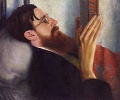 Lytton Strachey by Dora Carrington
 -
 John Maynard Keynes
 -
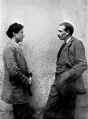 Duncan Grant and John Maynard Keynes
 -
 E M Forster by Dora Carrington
 -
 Vita Sackville-West
 -
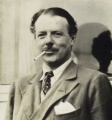 Harold Nicolson
 -
 Violet Trefusis aged 5, with her mother


References
<references>