
Henry Scott Tuke: Difference between revisions
Ross Burgess (talk | contribs) No edit summary |
Ross Burgess (talk | contribs) No edit summary |
||
| Line 10: | Line 10: | ||
==Further reading== | ==Further reading== | ||
''The life and work of Henry Scott Tuke | ''The life and work of Henry Scott Tuke 1858–1929'' by [[Emmanuel Cooper]]. [[GMP publications]], 1988. Paperback edition by Éditions Aubrey Walter, 1997. ISBN 0-85449-068-X. | ||
==Gallery== | ==Gallery== | ||
| Line 24: | Line 24: | ||
[[Category:Painters]] | [[Category:Painters]] | ||
[[Category:1858 births]] | |||
[[Category:1929 deaths]] | [[Category:1929 deaths]] | ||
Revision as of 16:20, 10 May 2014
_-_1920_-_Self_portrait.jpg)
Henry scott Tuke (1858–1929) was a painter, associated with the Newlyn School. His paintings are mainly in an impressionistic style, and many of them depict nude young men on the beach or in boats.
Tuke was born in York, but the family moved to Falmouth in 1859. Tuke attended a Quaker school in Weston-super-Mare and then studied at the Slade School of Art and in Paris. In 1883 he moved to Newlyn, joining an artists' colony, but in 1885 he moved to Swanpool near Falmouth where he converted a fishing boat into a floating studio and living quarters.
in 1914 he was elected to the Royal Academy.
Charles Kains Jackson dedicated a homoerotic sonnet to Tuke.
- This article is a stub. You can help the UK LGBT History Project by expanding it.
Further reading
The life and work of Henry Scott Tuke 1858–1929 by Emmanuel Cooper. GMP publications, 1988. Paperback edition by Éditions Aubrey Walter, 1997. ISBN 0-85449-068-X.
Gallery
-

-

-

-

-
 T E Lawrence as a cadet at Newporth Beach, near Falmouth
 -
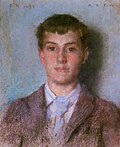 Frank Hird, painted for Lord Ronald Gower
 -


_-_1922_-_Lovers_of_the_sun_(Midsummer_Morning).jpg)
,_%22August_Blue,%22_1893.jpg)
,_Ruby,_gold_and_malachite,_1902.jpg)

,_1894.jpg)
